Invasive species
Procambarus virginalis
 racul marmorat
 Marbled Crayfish
 Marmorkrebs
 écrevisse marbréeracul marmoratMarbled CrayfishMarmorkrebsécrevisse marbrée
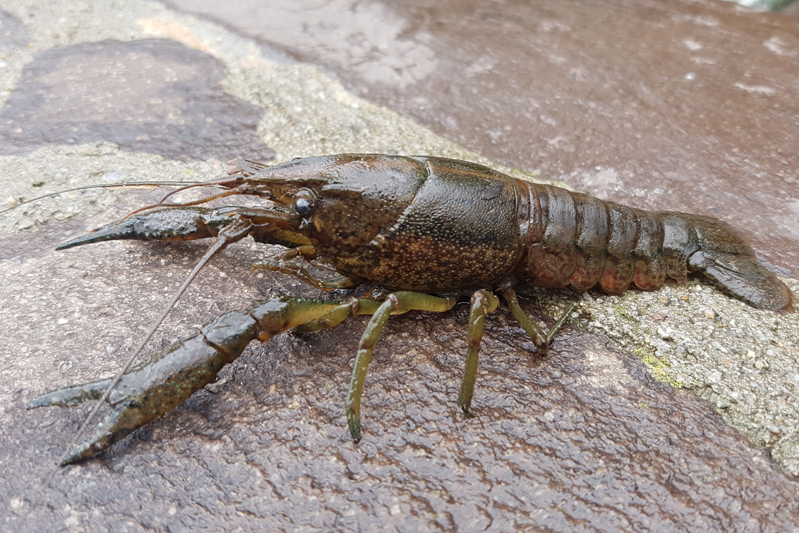
Small to medium-sized crayfish; adults reach 4–8 cm in total length. The species is characterised by a distinctive marbled coloration — the lateral sides of the carapace are covered with light and dark spots of varying sizes against a general brown background. Younger specimens may appear semi-transparent or show different colour variants. The ventral surface of the claws is lighter than the dorsal side. The rostrum is elongated with smooth, slightly curved margins and a triangular apex. There is a single postorbital ridge terminating anteriorly in a spine; the cephalothorax is smooth with spines only in the latero-posterior area of the cervical groove. The species is distinguished from its close relative P. alenii by its annulus ventralis, which is flat with a bell-shaped outline and lacks anteriorly peaked lateral wings.
This species originates from the aquarium trade; deliberate or accidental releases into natural habitats have led to the establishment of wild populations. It has been confirmed in wild populations in Croatia, Czech Republic, Germany, Italy, Sweden, Hungary, Slovakia, Ukraine, and even Madagascar and Japan. In Romania it was first recorded in ornamental ponds in Băile Felix (Sânmartin), Bihor County (Pârvulescu et al. 2017). Its Romanian distribution does not currently overlap with any other native or non-native crayfish. For the distribution map, visit the distribution page.
The Marbled Crayfish prefers warmer waters; frost can completely destroy populations because this species does not burrow. Established populations typically persist in calm, urban or semi-urban water bodies. Ecologically, this species poses a potential threat to native crayfish because it serves as a reservoir for the crayfish plague pathogen Aphanomyces astaci — a North American oomycete that causes mass mortality in native European species, which lack immunity. Entry into the Romanian aquarium market and misidentification by some aquarium owners means that individuals released into natural environments may found self-sustaining populations.
The anthropogenic origin of this species reflects the history of P. fallax in the aquarium hobby and a subsequent evolutionary transition to obligate parthenogenesis. The entire global population of P. virginalis consists exclusively of females, which develop embryos from unfertilised oocytes — meaning a single individual is sufficient to establish a new population. The precise timing of egg-laying in wild Romanian conditions is not yet known. Clutch size is large; since fertilisation is not required, reproductive potential is very high compared to bisexual species.